Style
Image consulting: colour, silhouette and face, explained without rules
Carolina Collaer · 24/10/2026
What an image consultation really looks at: the 12 colour seasons, the six silhouettes and the shape of the face (glasses and contouring). With illustrations and two examples of each, not a catalogue of rules.
Some clothes light up your face the moment you put them on. Others, lovely on the hanger, dim you down and you can’t quite say why.
There is almost always a reason, and it is rarely the garment. It is the colour next to your skin, the line of the cut on your body or the shape of the frame in front of your face.
An image consultation is there to name that reason. Not to change you, but so you can choose with judgement.
What an image consultation is (and isn’t)
It isn’t a uniform or a list of things you can’t wear. It is a reading of three things that don’t change from one season to the next, and one that does: where you are in life.
The first three have their own techniques. Here I explain the best known and most widely shared, with illustrations and examples:
- Colour: which shades light up your skin, your eyes and your hair (colour analysis).
- Silhouette: the proportion between shoulders, waist and hips (body shape).
- Face: its shape, which guides glasses, make-up and hair (face shape analysis).
- Your style and your moment: what represents you today, which no chart can know for you.
1. Colour: the 12 seasons
Colour analysis looks at three things in a colour. Its temperature: whether it leans warm (golden) or cool (bluish). Its value: whether it is light or deep. And its intensity: whether it is bright and clear or soft and dusty.
Crossing those three gives four families, spring, summer, autumn and winter, and each one splits into three. Those are the 12 seasons.
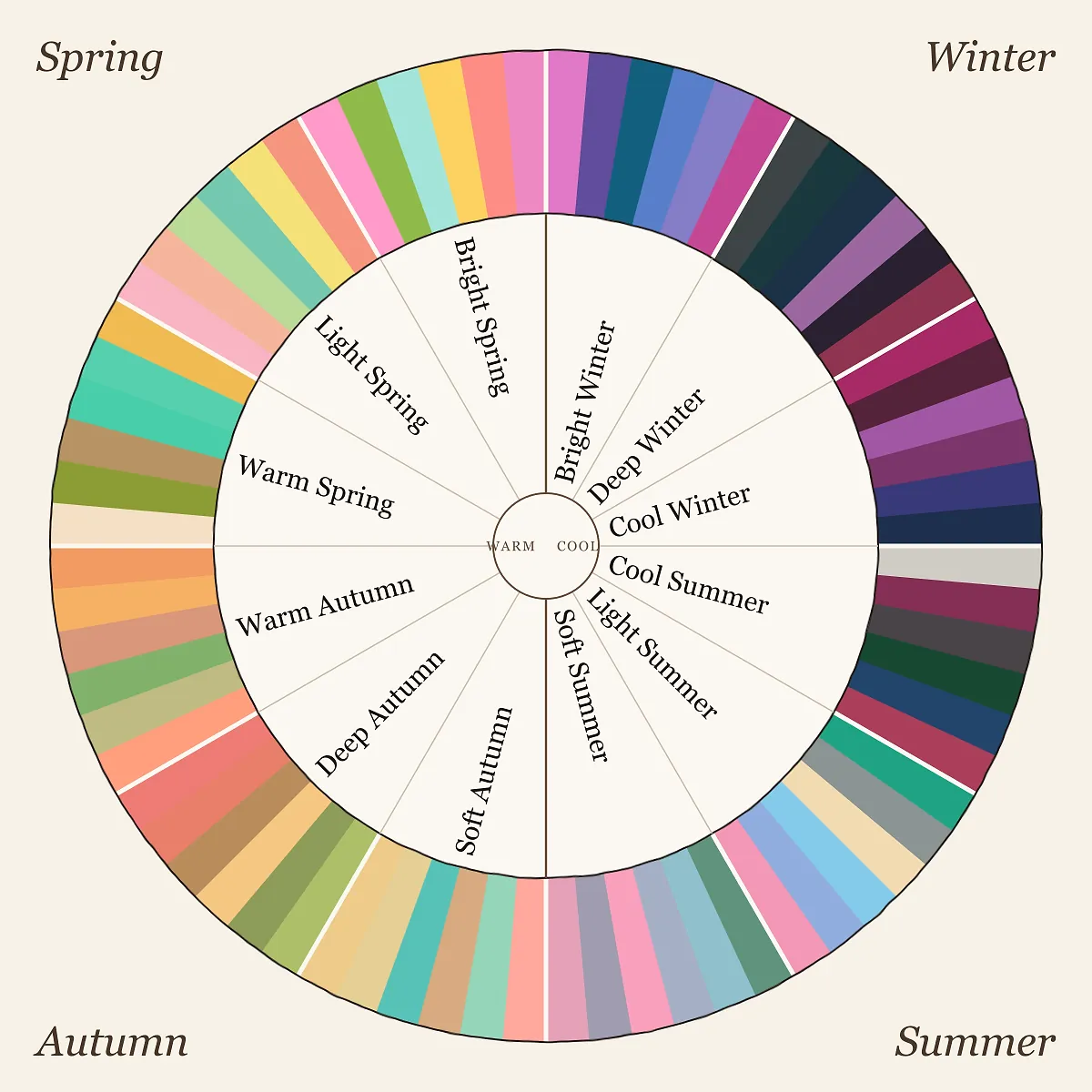
You read it like this: the further left, the warmer; the further right, the cooler. The seasons at the top want clear colours with contrast; those at the bottom, blended colours with a touch of grey.
Two opposite examples. A Bright Winter looks her best in high contrast: clear red, emerald green, intense blue, fuchsia, black and white together. A Soft Autumn wins with the opposite: camel, sand, soft salmon, muted greens and blues, nothing that shouts. Swap them and the first looks tired while the second disappears behind her clothes.
The professional touch is in how you look: in daylight, with a bare face and the test fabrics under the face, one by one. If you’d like a first clue from home, play COLORIMETRY ME!, CARO’s game: it suggests a season and shows you its colour card. It is a starting point, not a diagnosis.
2. Silhouette: six shapes of proportion
Body shape isn’t about size or weight. It compares three widths, shoulders, waist and hips, and gives them the shape of a letter. None is better than another: each has its allies.
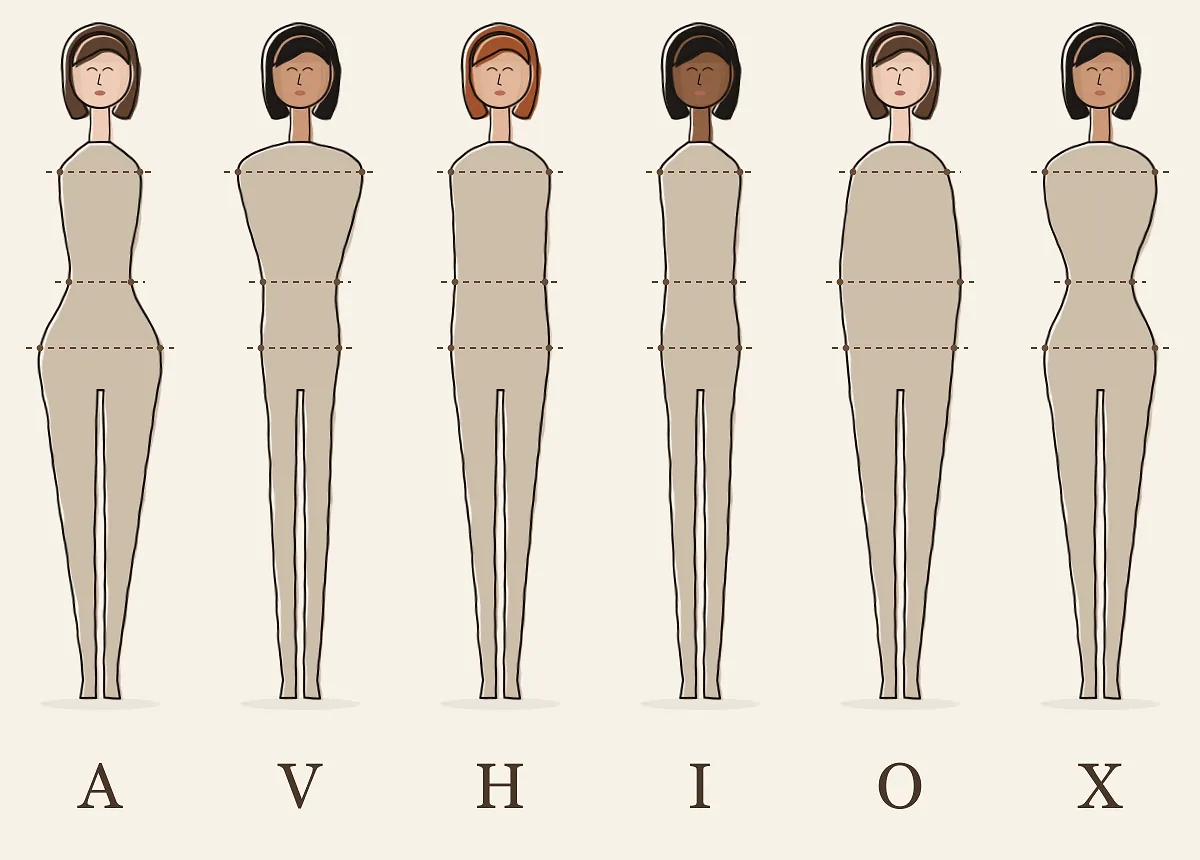
- A: hips wider than the shoulders, often with a small waist.
- V: shoulders or bust wider than the hips.
- H: shoulders and hips aligned, little waist definition.
- I: like the H, on a slender, narrow frame.
- O: curves gathered in the middle, with the waist as the widest part.
- X: balanced shoulders and hips with a well-defined waist.
The idea is not to “correct” the body but to balance lines: draw the eye where you want it and quieten the rest. Two examples, so the logic is clear.
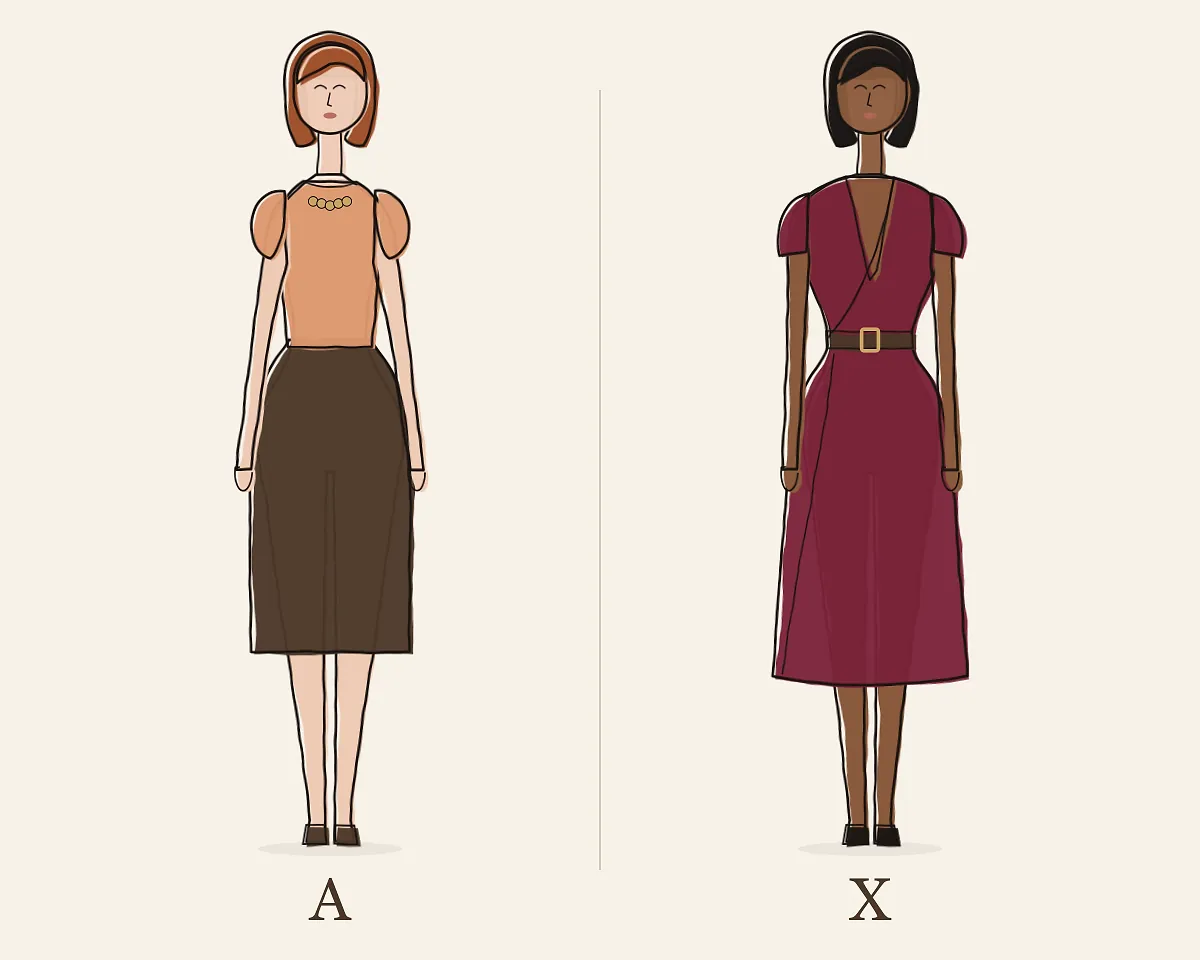
Example 1: the A silhouette
Here all the interest goes up top, to balance hips wider than the shoulders. A coloured blouse with puff sleeves and a boat neckline visually widens the shoulders; a statement necklace draws the eye up to the face. Below, the opposite: a straight or slightly A-line skirt, in a dark plain shade, in a fabric that falls without clinging, with no side pockets or ruffles. And the blouse tucked in: a long tunic that ends right at the hip points to the very area you wanted to quieten.
Example 2: the X silhouette
If your waist is defined, the job is not to hide it. The wrap dress is its great ally: the wrap draws the waist and the V-neck lengthens the neck. A belt at the natural waist and high-rise skirts or trousers follow the same logic. For a coat, a trench tied at the waist rather than a straight coat: shapeless pieces, however beautiful, turn an X into an H.
3. The face: glasses and contouring
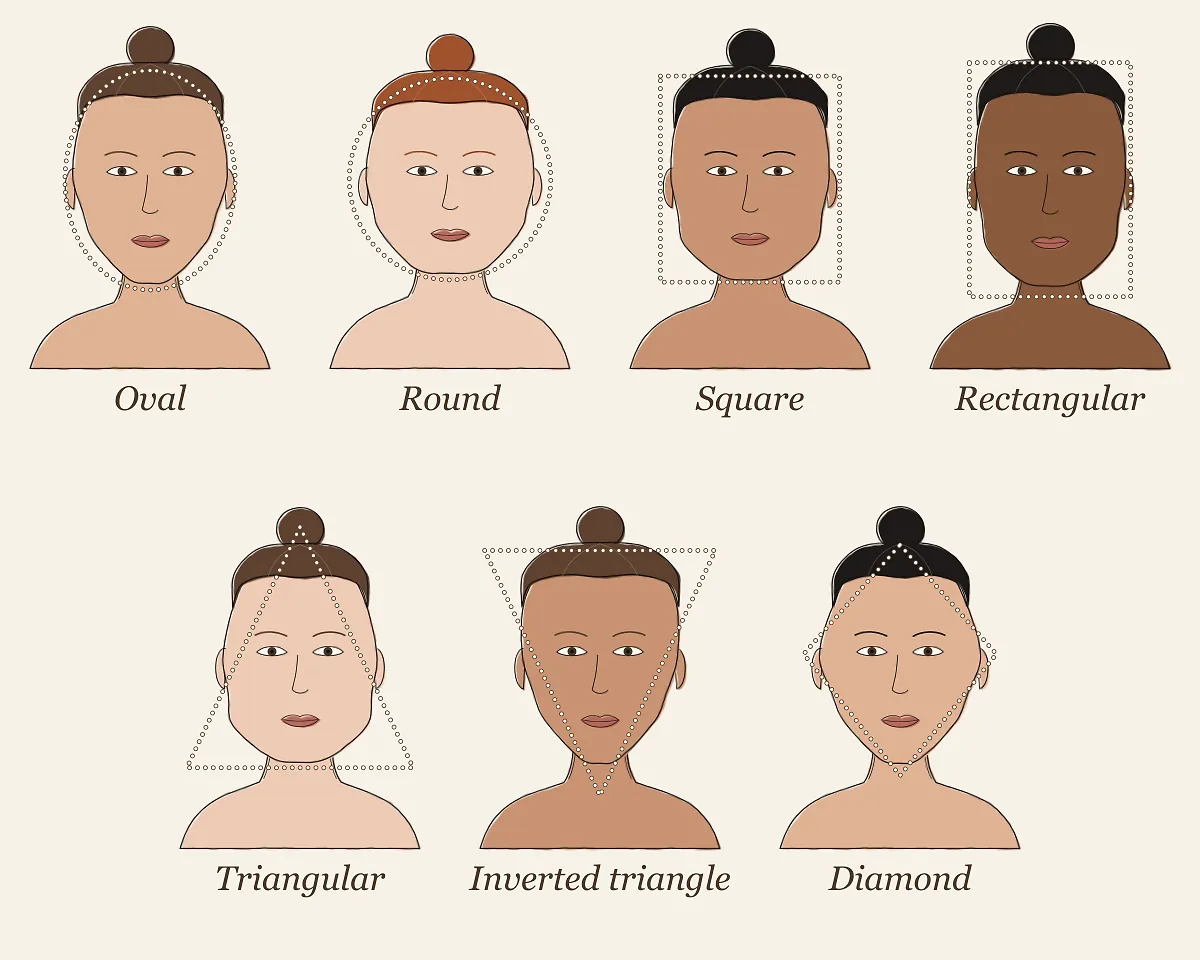
Face shape analysis starts from the shape of the face. CARO’s cards cover seven: oval, round, square, rectangular, triangular, inverted triangle and diamond. The principle is nearly always the same: the frame brings what the face doesn’t have.
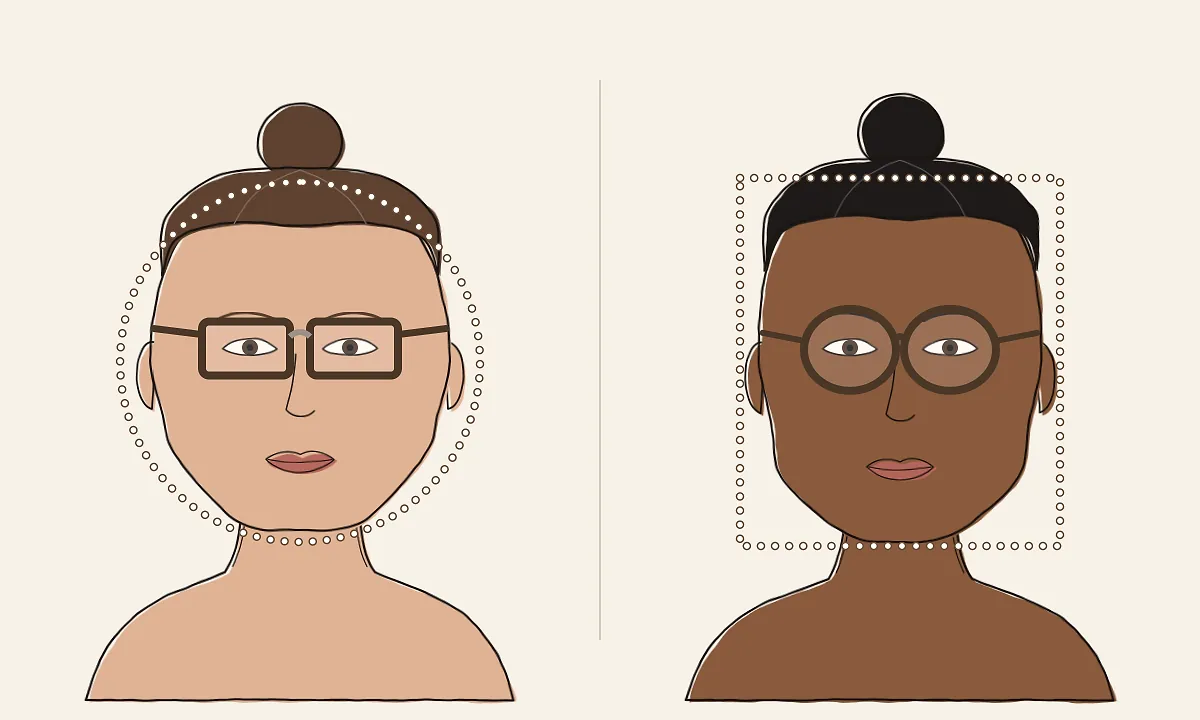
On a round face, with curved lines and almost as wide as it is long, a slim angular frame, slightly wider than it is high, slims and lengthens; a light bridge opens up the eyes. On a square face, with a wide forehead and jaw, the opposite works: rounded or oval frames in light metal, which soften the angles, and never wider than the face itself.
Three rules work for every shape: the frame doesn’t hide the eyebrows; it doesn’t go beyond the widest part of the face; and the bridge is chosen with the nose and eyes in mind (dark and low if the eyes are wide-set or the nose is long, light and higher the other way round).
Contouring: light and shadow
Make-up follows the same idea with two tools: shadow recedes and light brings forward. Light almost always goes to the same places: the centre of the forehead, under the eyes, the bridge of the nose and the chin. Shadow is what changes with the shape of the face.
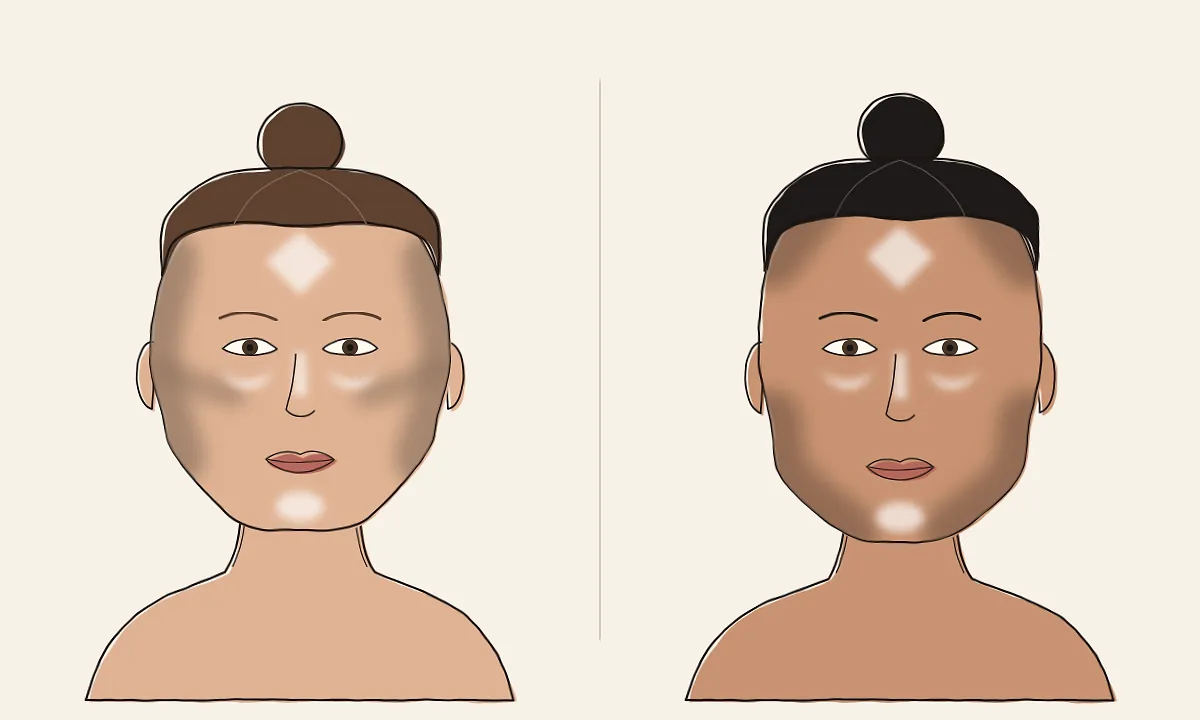
On a round face, the shadow runs down the sides, from temple to jaw, with a touch under the cheekbone: the face looks longer. On a square face, the shadow goes to the four corners, the temples and the angle of the jaw, to round them off. In both cases, a matte shade slightly darker than your skin and very well blended: if you can see the line, there is too much product. Eyeshadow, on the other hand, depends on the shape of the eyes, not of the face.
Keys to guide you (and a professional eye)
These are the best known and most widely shared techniques of image consulting, and they already give you plenty of keys. With a little practice and some reading, they let you guide yourself simply and effectively: look at your wardrobe with fresh eyes, choose a frame with judgement, understand why a colour suits you so well.
But image consulting is more than a sum of techniques, and none of them replaces the real eye of an image consultant. She crosses them with each other (an A silhouette with a square face and a Soft Autumn palette doesn’t dress like another A who is a Bright Winter) and with what no chart measures: your style, your work, how you want to feel.
And if at some point you’d like that support, CARO is here. Carolina has been advising since 2017: she has worked with clients in Belgium and the United States, and today she does so from Spain. We work in person, with light, fabrics and your own wardrobe, in the CARO Session · Image & Presence or in an Essential session, focused on a single question. You’ll find everything in our image consulting services.
What I wouldn’t do
- I wouldn’t follow a chart to the letter: it is a map, not a law.
- I wouldn’t empty my wardrobe after discovering my season. Moving a colour is usually enough: away from the face, into trousers or a bag.
- I wouldn’t keep a label forever: hair, skin and life change, and the reading can change with them.
Frequently asked questions
Can I find my season on my own, with a test?
A test or a game like COLORIMETRY ME! gives a good clue and teaches you to look. Confirming it takes daylight, test fabrics and a trained eye: between two neighbouring seasons, the difference is subtle.
What if I’m between two silhouettes?
That is very common. The letters are references, not boxes. You take the closest one and adjust with the other: an H with some waist, for example, can borrow ideas from the X.
Is image consulting only about buying new clothes?
No. Most of the work is done with what you already own: new combinations, pieces brought back to life and a short, honest list of what is really missing.